Frogsleap Farm

Frogsleap Farm

Thursday, April 7, 2011

Building with Brix

Although tomato fanatics will argue on relative taste of various tomato varieties, it is generally recognized that there are three major components to taste in tomatoes: sugar content, acidity, and volatile flavor compounds (reference).  The right balance of sweetness and acidity is crucial, but generally higher sugar content makes  for better tasting tomatoes (reference). Sugars are the predominant component of soluble solids in tomatoes.  Soluble solids content (Brix units) is easily measured with a hand held refractometer. 

Brix level in most tomato varieties varies between 4-6%, with popular cherry hybrids like SunGold and Sweet Million being notably higher.  To boost soluble solids content in tomatoes, breeders have recently incorporated genes from wild relatives.  This has resulted in a new generation of super sweet tomato hybrid cherry and grape types with reported >10% Brix.  Many of these new hybrids also contain the rin gene for longer shelf life, and have improved resistance to fruit cracking.  Seed for most of these is only available to commercial growers, so thanks to my various Tomatoville friends for helping us to access seed this winter.

This summer we are growing out F1 and/or F2 generation plants of several new super sweet grape/mini-plum hybrids for crossing to our best striped cherries, saladettes, plums, hearts and beefsteak types.  We hope to incorporate higher Brix, longer shelf life and improved disease resistance from the commercial hybrids to our “heirloom derived” breeding lines.
  
TGRC photo
A particular TGRC accession of S. galapagense (L.cheesmanii minor) from the Galapagos Islands has been reportedly widely used as a breeding source for high soluble solids.  In this research study (publication link) LA530 tips the scales at 13% Brix, more than double any of the commercial cultivar checks.  We are also growing this beast this summer, probably making a few crosses, but mostly out of curiosity.  Note the strikingly different fruit type.  Seedling vigor is also unique, and not in a good way.  An interesting side note is that LA530 also has high salt tolerance and under salty conditions gets even a little sweeter!

Taste is not all about Brix, but we are betting high Brix is a good building block for improved flavor (pun intended).  We should have F2 populations from these new crosses to taste test in 2012.

Saturday, March 5, 2011

Breeding for the Blue Tomato


Our darkest F2 fruit
Blue tomatoes, not really - the fruit are really more of an indigo color; the pigmentation more like an eggplant.  So what's the fuss about and what's the genetic basis for the accumulation of anthocyanin pigment in tomato fruit?  Here's what we've learned from the literature and from our experience in breeding for the trait.


In the last several years there’s been significant interest in breeding tomatoes with improved nutritional quality.  One approach has been to increase fruit concentration of anthocyanin and related phenolic compounds that also have anti-oxidant activity.  Professor Jim Meyers, and various graduate students working with him at Oregon State University (including Jones, Mes, Boches and Dalotto), have used TGRC lines to introgress, into cultivated tomato, two genes from wild relatives that independently regulate anthocyanin synthesis in tomato fruit.  This group has published most of what is known about the genetic basis for the trait (see Jones, 2003 link).  We are among a group of several tomato breeders working on incorporating these genes into various tomato breeding lines.  The Aft/atv parent we used in crossing was a single plant selected in our breeding nursery from OSU Blue for intense anthocyanin accumulation in the fruit and acceptable horticultural type.  Taste of this OSU Blue "donor plant" was not very good.

Aft fruit cross section - pigmentation
accumulation limited to surface
layers of cells  (P. Boches photo)
The Aft (anthocyanin fruit) gene, from S. chilense, is a regulatory gene (An2 transcription factor) that is induced by UV light and that triggers up-regulation of anthocyanin biosynthesis in tomato fruit, and to a lesser extent in vegetative tissue.  In Aft plants anthocyanin accumulates in and just below the fruit epidermis, where light penetrates the first few layer of cells.  It is believed that such accumulation is a stress and protection response to UV light (think melanin accumulation in human skin cells in response to UV light – tanning).  Typically those parts of the fruit exposed to light will accumulate anthocyanin and turn black/purple, while those parts of the fruit not exposed to light will have the normal background fruit color.  Anthocyanin accumulation begins very early during the green fruit stage and masks normal fruit color in mature fruit.  Anthocyanin appears to accumulate preferentially in the green stripes of gs and Fs fruit.

 Todd Dalotto photo
The atv (atroviolaceum) gene, from S. cheesmaniae, induces anthocyanin accumulation in vegetative tissue and, in combination with Aft, to anthocyanin accumulation in tomato fruit.  Plants homozygous for atv accumulate anthocyanin in leaves, stems and petioles, especially in conditions with high light and cool temperatures. 

Co-expression of Aft and atv have a synergistic effect on fruit anthocyanin production (see Povero 2012 link).  For this reason a breeding program for anthocyanin accumulation in tomato fruit needs to select for both Aft and atv.  Here’s what we have learned from evaluating several hundred plants from six F2 populations segregating for both Aft and tav:

Under cool high light conditions seedlings homozygous for atv will begin accumulating anthocyanin in the cotyledons and the epicotyl.  This accumulation will become more obvious as the seedlings get larger.  Maintaining cool temperatures and high light is critical for successful selection of atv/atv seedlings at this stage.
F2 seedlings segregating for
pigmentation in cotyledons

This dark purple PL seedling did not produce
fruit w/ any anthocyanin pigmentation

Once the seedlings establish in the field and the temperatures increase, the anthocyanin accumulation in leaves/stems fades quickly.  Later in the season when the temperature begins to drop, anthocyanin accumulation in vegetative tissue (especially growing points) starts anew.

Differences in pigmentation at transplanting within a F2 family,
each selected weeks earlier for seedling "purpling"

Some of seedlings with the darkest “purple” foliage had no anthocyanin accumulation in the fruit (atv positive/Aft negative).  In fact there was no significant relationship between seedling score for anthocyanin and anthocyanin accumulation in fruit.  This was a surprise, and suggests not being too rigorous in screening seedlings.  In 2010 we selected < 5% of the F2 seedlings for transplanting – based on the anthocyanin phenotype in seedlings.  This is probably more severe than needed.  Among seedlings showing some anthocyanin acculation, there is a considerable variation in degree of purpling (see photo above).  This may be an interaction between atv and Aft or other unknown genes.


Early fruit pigmentation 

Pigmentation is local and only where fruit is exposed
to direct sunlight
Anthocyanin shading on the sunny side of this F2 fruit
4    Anthocyanin accumulation in fruit (primarily due to Aft) begins very early in fruit development – but only in young fruit exposed to light.  Because early fruit is often deep in the canopy, we do some early pruning to improve light exposure, enabling the Aft phenotype.  Late in the season, with better fruit exposure to sunlight and cooler temperatures, we saw stronger expression of the Aft phenotype.
5    Among F2 segregants showing some anthocyanin accumulation in fruit, there was very significant variation in early season intensity of the pigment, and how sensitive such accumulation was to light.  Part of this may be due to whether Aft was homozygous vs heterozygous (i.e. partial dominance – suggested by Jones), but it appears there may also be interactions with other unknown genes.  We should learn more from the F3 generation.

Our best tasting F2 - a bicolor orange w/ indigo highlights

6    In the F2 generation there didn’t appear to be any relationship between anthocyanin accumulation in the fruit and flavor/taste.  Taste of fruit from the best F2 plants with a strong Aft fruit phenotype were 7.5-8.0 on a scale of 10.  There’s still some work to do here.  This year we will have F3 progeny from the best Aft lines and backcrosses of these to our best tasting non-Aft breeding lines.
Aft/gs

Indigo striped cherry


      As described in our “Genetic control of fruit stripes” blog, we saw a preferential accumulation of anthocyanin in green stripes in fruit of F2 plants co-segregating for gs and Fs.  This should yield some pretty interesting and novel looking F3 fruit in Aft/gs  and atv/gs plants with various fruit color/shape combinations.  Purple Dragon is Dean Slater's name for a F3 line combining Aft/gs.  Black and Brown Boar was the striped parent in the F1, which I think is evident here.

Late season w/ plenty of light exposure to fruit and cooler temperature


High pigment mutants hp1 and hp2 dg are lesions in regulatory genes (transcription factors) that regulate light-signaling in tomatoes.  Homozygous hp plants show several novel developmental and metabolic phenotypes, including increased fruit pigmentation and accumulation of various flavonoid phytonutrients.  A combination of hp1 or hp2 dg with Aft and atv show >20x enhanced anthocyanin accumulation in tomato fruit, see photo here.  The hp  phenotype generally also results in negative effects on plant vigor and fruit yield.  The combination of hp and Aft/atv is subject to a U.S. patent application (patent application link).


----------------------------------------------------------------------

Here's a 2012/13 update.  With a few exceptions it appears that to get exceptional flavor in an Aft/atv line it will require two generations of crossing (a cross and a backcross/modifed backcross) of P20 to a high flavor parent.  We have several nice MBC1 lines now in the breeding program  One exception is the Indigo Tiger cherry shown above and now in the F5.  In 2012 I planted the new OSU release Indigo Rose (OSU press release).  Good anthocyanin expression but flavor was just fair, not good enough for me to want to plant again.  I've also tried several of Tom Wagner's Aft lines and found a few interesting plants in these widely segregating populations.  One of the best was a green when ripe (GWR) line with anthocyanin stripes, from a line he called Muddy Waters.  We used this in several crosses in 2012, and some interesting F2s from these in 2013.


Selection from Muddy Waters
MW x GWR breeding line - F2
We had a chance to visit Brad Gates (Wild Boar Farms) in 2012 and he had several Aft/atv lines, including a couple of ours.  Here's a photo from his nursery of an Aft line tracing to a breeding line of ours we call Freckled Strawberry.  Note the indigo freckles and shoulder on this unripe fruit.  The bottom photo is from a similar Aft Freckled Stawberry line from our 2013 Pennsylvania nursery - top fruit from within the canopy (no light, no anthocyanin) and bottom fruit exposed to light on one side with anthocyanin present.


Aft Freckled Strawberry

We've found another interesting manifestation of Aft/atv in a segregating breeding line tracing to our cross P20 x Beauty King.  Note the "tiger stripes" pattern.  Although we are yet unable to stabilize the phenotype, anthocyanin accumulates in lateral stripes on developing and ripe fruit (coexpression w/ Fs gene).  The Fs phenotype appears to be highly influenced by environment, complicating the breeding.  This photo is also from our 2013 Pennsylvania nursery - nickname for now is Bengal Tiger
.
Bengal Tiger


Saturday, February 19, 2011

Genetic control of fruit stripes in tomato

Over the last few years we’ve made many dozen crosses between various striped types and the best tasting heirlooms.  Most of the striped parents were from Brad Gates at Wild Boar Farms, but there were others too.  In studying the F1 and F2 progeny from these crosses, reading what is in the literature, and listening to the experience of a couple respected colleagues – here’s what we’ve learned about genetic control of stripes in tomatoes.

We believe there are at least three different patterns for fruit striping in tomato, all under different genetic control.  All three result in tomatoes that are striking in appearance, and since there seems to be no relationship between fruit stripes and taste or horticultural traits, a tomato can be both great looking and great tasting.


homozygous gs in unripe fruit
According to the Tomato Genetic Resources Center (TGRC) the green stripe (gs) gene causes "irregular longitudinal green stripes in the epidermis of unripe fruit; retaininng chlorophyll for longer period during ripening, and eventually assuming paler color in fully ripe fruit; changes limited to the epidermis".  Generally the color of the stripes in mature fruit is green in fruit with the gf trait (purple, brown and GWR flesh types with retained chorophyll)) and yellow in non-gf types (e.g. red and yellow).  There are exceptions.  The pattern and boldness of the stripes can vary widely.  Casady's Folly shows bold lightning bolt-like stripes.  Others appear to be washed with a gold or metallic green paint (conditioned by gs), with the underlying fruit color appearing as stripes (see photos below). Although the gene is generally considered to be recessive, the gs/+ heterozygote may show faint striping - but not always.  Clearly there are one or more genes interacting with gs which provide for the rich diversity of striping color and patterns.  We know now for example that in anthocyanin fruit (Aft) types the anthocyanin pigment accumulates preferentially in the green stripes - evident in both green unripe and ripe fruit.  Some examples of the diversity are shown in photos below.


gs - yellow stripes on red
gs = green stripes on brown
F2 segregates
Heterozygous gs - faint striping
Casady's Folly
Aft/gs combo
Red - dipped in gold
Red - dipped in green

Fs drawing (from Keith Mueller)

The fruit stripe gene (Fs) causes dark green radial stripes opposite the fruit locules.  These radial stripes tend to fade as the fruit matures.  I have only seen radial stripes on ripe fruit on green flesh (gf) types, for example Indian Stripe or Arbuznyi.  An exception to this may be with Aft fruit, where again anthocyanin appears to preferentially accumulate in the stripes (e.g. Siberian Tiger and Bengal Tiger).  I’ve only seen this one example on a red/orange Aft fruit, so there’s more to learn here.  Expression of the Fs trait is highly dependent on environment - a real frustration when it comes to breeding for these striking radial stripe patterns.

Prominent Fs on ripe purple fruit
Fs in apricot background, unripe fruit (Keith Mueller)
Siberian Tiger - Aft/Fs
Bengal Tiger

We believe there is a third unrelated striping pattern that is evident in some bi-color types.  These broad (often red or orange) stripes radiate in a regular pattern from the blossom end, and I’ve only seed this in orange/red/yellow or green/red bi/tri-color type fruit.  Unlike gs and Fs, these stripes are not evident on unripe fruit.  The color comes from below, rather than in the epidermis.  I think the Wild Boar Farms varieties Beauty King, Beauty Queen and Berkeley Tie Dye (BTD) are examples of bicolor types that may have both gs and radial bicolor striping (note: Gates says Beauty King was derived from a cross between the bicolor Big Rainbow and Green Zebra).  I have not been able to find much in the literature on heritability of the bicolor trait in general or of this unique radial striping pattern – but based on F2 progeny from crosses with BTD and BK there is likely more than one gene involved, and the traits tend to both be recessive.  This summer we’ll have several unrelated breeding lines segregating for this pattern of fruit coloration – so more to come later.

Yellow/Orange bicolor w/ radial stripes
Butt end of BTD type bicolor
Cross section of BTD type bicolor

The interaction between these three independent traits, each resulting in a unique pattern of stripes on tomato fruit, and the effect of interactions with other genes (e.g. gf and y) on these traits make for a wide variety of striped phenotypes, and complicated genetics.   Over the next few years it will be fun sorting out segregating progeny from crosses we’ve made between parents expressing these various genes.

2011 crosses 


Saturday, December 18, 2010

Freckles

Scabitha
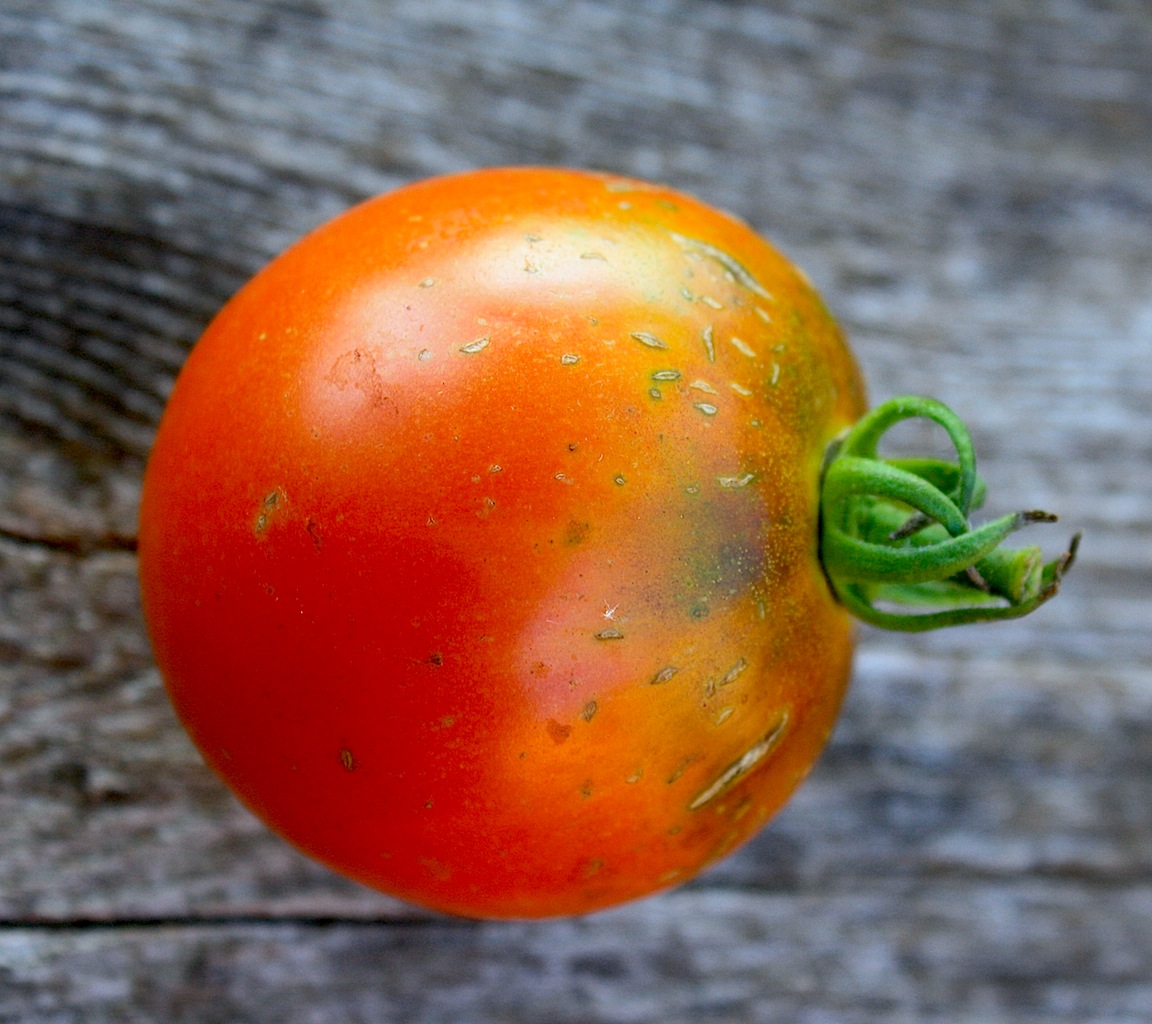
One person's beauty mark is another person's mole.  So it is, I think, with “freckles” on tomatoes.   My first experience with this trait was with seed I got in trade of the variety Scabitha, which was attributed to Brad Gates at Wild Boar Farms.  I was impressed.  The fruit was meaty and tasty and the skin had random gold flecks that were interesting and unique.  One of the plants from this seed appeared to be an outcross, with smaller heart shaped fruit and a different expression of the “freckles” trait.  I made a cross to the true-to-type Scabitha, and saved OP seed from the odd ball.

Freckled Strawberry
Next year the odd ball got odder, and the first F1 showed that the “freckles” were heritable, and partially dominant.  Again I saved seed of the oddest of the oddballs (Freckled Strawberry) and made more crosses.
Dora x Scabitha F1
In the meantime I started trying to learn more about this unusual trait.  Here’s what I think is going on.   Fruit pox and Gold Fleck are physiological disorders that are often found together but are considered separate conditions (reference here). Fruit Pox is described as small cuticular disruptions 
found at random on the fruit surface. The number can vary from a few to many.  Gold Fleck shows up as small irregular shaped dark green spots at random on the surface of immature fruit which turn to a gold color as fruit ripens. Number of spots can vary from few to many.  There are reported genetic differences in susceptibility to these conditions (see here), and Scabitha and some of my lines seem genetically predestined to Pox and Gold Fleck – hence the “freckled” phenotype.
Mature/Immature fruit


Here’s a photo showing the Gold Fleck phenotype on immature green fruit and on a mature red fruit.  In my various Freckled Strawberry lines the green fruit stage is heavily peppered with black dots, which will later turn gold.  Although  high expression of the pox phenotype is a little over the top, moderate freckling in the F1/F2's look interesting.  There does not appear to be any relationship between "freckles" and any important horticultural traits (e.g yield, taste or fruit texture).  

Immature Freckled Strawberry
Freckled Child

A few other observations:  the “freckled” phenotype is influenced by environment, with higher expression later in the season; one F2 plant appears to have pox, without gold fleck – so maybe these conditions are somewhat independent; and there are other freckled phenotypes that are probably not related (e.g. WBF Freckled Child).


An August 2011 update:  in a new “freckles” breeding line I was able to find a plant with fruit that had gold fleck (freckles) and without fruit pox (scabs).   Interestingly in this fruit the freckles seemed to align in a fashion that suggested lateral “stripes” of gold spots.  I crossed this plant to a darker skinned/fleshed tomato hoping for gold on dark purple.  That’s a combination you can’t do with the gs (green stripe) gene – see the breeding for stripes blog entry.  Also this year we found an unusual variation on the freckled phenotype in a F3 plant from the cross Scabitha x Boar's Hoof -freckles w/o pox, but the freckles are tan, not gold.


Freckles in stripe pattern


(Boars Hoof x Scabitha)F3
Jessica (the plant pathologist) thinks this project is a dry hole, and wants nothing to do with it.  Mark is intrigued … but on his own on this one.  For now Mark, ever the optimist, is avoiding using the term pox, in favor of “freckles”.  More to come as Freckled Strawberry is stabilized and several Scabitha or Freckled Strawberry F2’s get planted out this spring.

Sept 2013 update - We have been able to introgress Aft (anthocyanin fruit) into our Freckled Strawberry germplasm.  The desired effect was gold freckles on a indigo skin (like bright stars on a night sky).  This is a work in progress, but looking interesting.  In this photo there are two fruits from the same plant, one fully ripe from deep in the canopy (no direct sun, no anthocyanin) and one from the top of the plant (below in photo) showing anthocyanin accumulation on the side of the ripening fruit exposed to the sun.  We like the look of these, but they are not yet stable.


The photo below was taken at our NC breeding nursery in  July 2014.  Two plants in a row of a hundred showed this very striking gold freckles on indigo.  


Saturday, December 11, 2010

Crossing and Seed Saving

There are several online sites that cover basic techniques for crossing and seed saving, and we've learned from all of them.  One of the best on crossing is here.  Here's a photo of Mark's crossing tool box:  scissors for trimming back to a single flower, and when necessary for trimming petals during emasculation;  a set of very sharp forecepts - the primary emasculation tool; colored wire ties to help you find the emasculated flowers the next day; a glass lens from a discarded pair of sunglasses, on which to collect and apply pollen; and some brightly colored tags to label the crossed flowers after pollination is complete.  I also use reading glasses to better see what the heck I'm doing.


Emasculated flower ready for pollination
I've had best success emasculating after work on day 1, and pollinating the following day after work.  This allows emasculation of very young un-opened flowers, and pollinating 24 hrs later when they are more mature (and receptive).  I very rarely get any accidental self pollination with this method.  Some hints on timing of pollination - I like at least 24 hrs of dry weather after pollination to make sure rain doesn't wash off the applied pollen, and I have most success when I pollinate early in the season (e.g. June), before it gets too hot.  The problem with early pollination is that you haven't had a chance to fully phenotype the parents yet (if they are from a segregating population).


Ripe fruit ready for F2 seed extraction


Fermenting in zip lock bags

I usually extract seed from the ripe fruit in the field (saving messing up the kitchen) and plop the seed and pulp right into a ziplock bag, labeled with a water proof sharpie. After fermentation in the basement for a few days, I wash the seed, dry and store in a coin envelope.